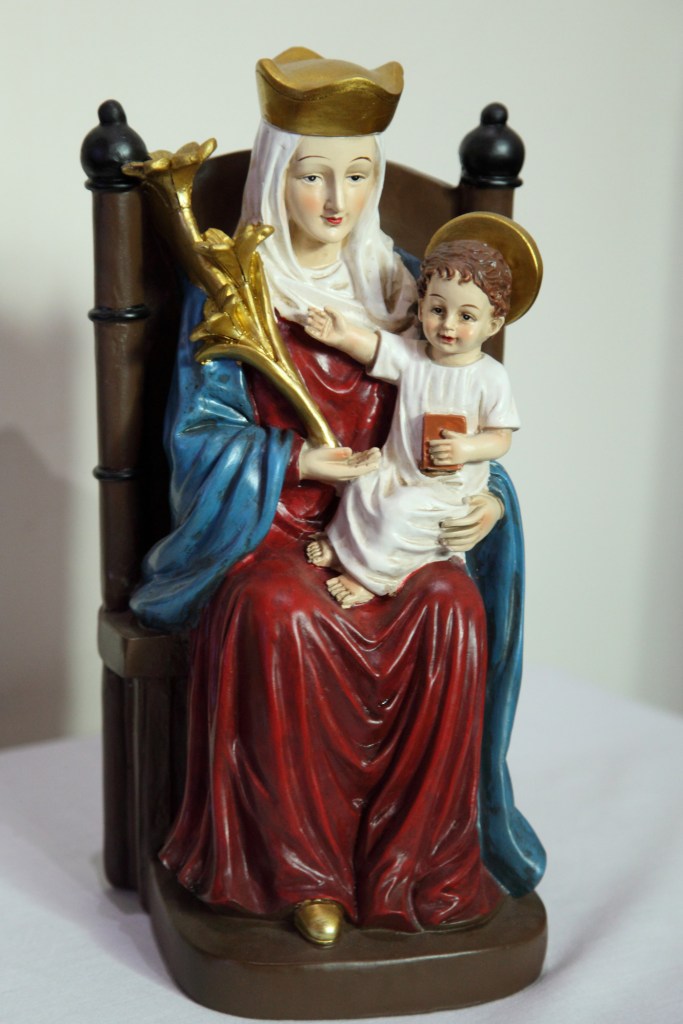
The Cell of the Holy House of Our Lady of Walsingham and S. Joseph based at All Saints’, South Wimbledon.
Cell Superior: – Fr. Christopher Noke.
Cell Secretary: – Miss. Jenifer Hardy
The Cell meets bi-monthly, on a Saturday in All Saints’ Church, South Wimbledon, for a Mass dedicated to Our Lady at 12 noon, followed by refreshments and a meeting.
The main purpose is to promote interest in, and pilgrimages to, the Shrine of Our Lady at Walsingham, and it aims to make a weekend pilgrimage to the Shrine once a year – usually near the beginning of the school summer holidays.
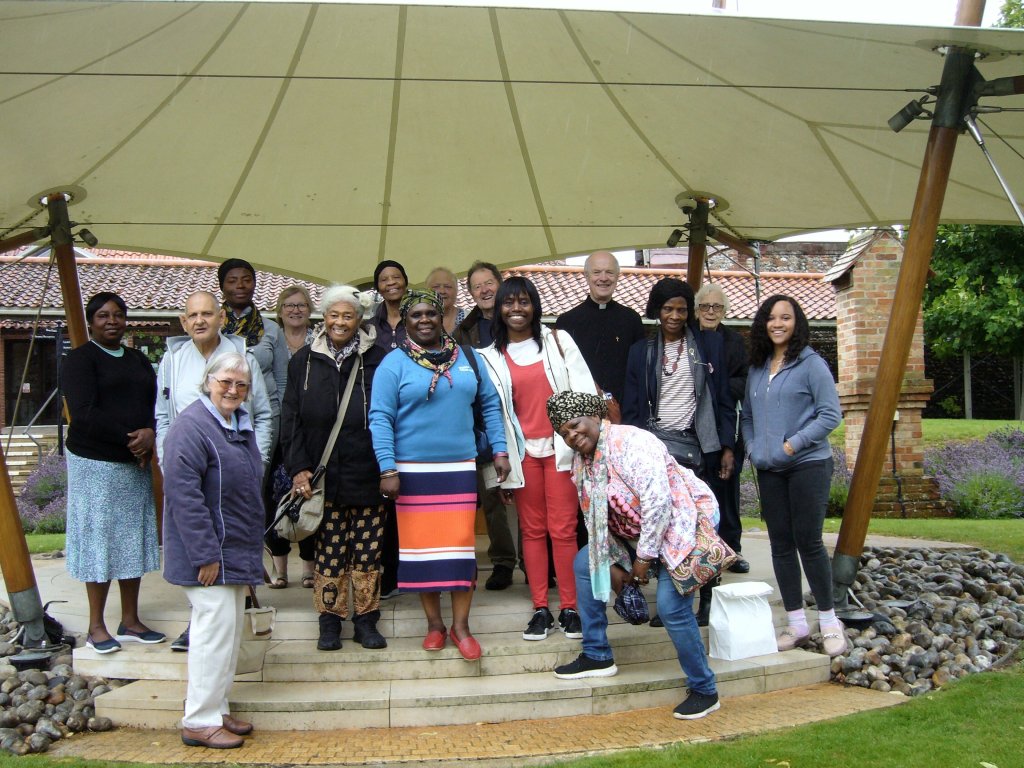
WALSINGHAM REVISITED
July 2023
Anyone who had not come on our annual pilgrimage for a couple of years, seeing unfamiliar townscapes whizzing past the green glass windows, might have been forgiven for asking: ‘Where are we?’
‘Baldock.’
‘What happened to the Dartford Crossing?’
‘We come round West London now. Avoiding the Dartford Crossing. Some people have wasted their entire lives on the Dartford Crossing.’
Otherwise, on re-revisiting my previous account of our pilgrimage, little seems to have changed.
English weather of course remains reliably unreliable. In 2019 we had four hot, sunny days. In 2023 we have been coping with a traditional English summer. Seeing the forecast one might have been forgiven for packing extra, wet-weather gear. But finding that fortunately forecasters seem prone to excess, we were rewarded with dry and delightful walks and outdoor services.
Thus, here is the evergreen Walsingham experience, much as most years.
…..
No, Norfolk is not “very flat”. Had Amanda, origin of the quotation, in Noel Coward’s Private Lives, been to Walsingham, instead of indulging in a fit of sour grapes, she would have found herself in gently hilly countryside, and perhaps managed to dispel another myth – Norfolk’s breezy North Sea climate is far from perpetually chilly. When you’re next in Walsingham just look at the nuns’ flourishing vineyard on the green hillside, along which we enjoyed afternoon walks between the Anglican and Catholic shrines, among a forest of wild flowers and vividly coloured butterflies. One of our pilgrims has the pictures on her phone to prove it.
Others had the opportunity of a short bus ride to seaside ice-creams.
In this clement climate, the gardeners who so skilfully tend the close at the Anglican Shrine manage to coax myriad blooms and exotic plants out of its fertile and sheltered gardens. These gardens are the setting for one of my favourite services of the pilgrimage, our parish Stations of The Cross, up and down the hilly lawns, the high point surmounted by three wooden crosses, representing Calvary, then culminating below in an eerily realistic tomb into which our pilgrim group could just squeeze, hoping there is no stone that could be rolled up against its entrance. [There isn’t!]
The centrepiece of this 20th Century restored Walsingham is a replica of the pre-Conquest Holy House, itself an imagined recreation of the one in which The Annunciation occurred. It was founded to memorialise the spot where The Blessed Virgin appeared in 1051, during the reign of Edward The Confessor. At the front now is a full-size and rather wonderful copy of the 15th Century plaque of the Annunciation in glazed blue and white terracotta, after the altarpiece in the church where St Francis of Assisi received the stigmata. In the background to latter day Walsingham stand the ruined gothic Abbey and, climbing the hillside, the remains of a Franciscan Friary, both daunting and jagged against the evening sky. Memento mori in perpetual stone. Hauntingly atmospheric when Walsingham is still as the grave, after the day-trippers have departed. Like Glastonbury and Tintern Abbeys, they remain among the marks of a Tudor despot all over an England once known as Mary’s Dowry.
Before his reign of terror, as a young man, Henry VIII pilgrimaged to Walsingham, devoutly completing the final mile barefoot, though as a sour older man, perhaps in an Amanda-like mood, he ordered its despoliation. It lies in ruins, testament to political opportunism, greed and intolerant zeal.
Unlike Henry, we do not walk barefoot – well not so far – but travel door-to-door in an air-conditioned, Mercedes motor-coach. Nor do we endure the privations of Tabard-like inns, but most enjoy the luxury of en-suites and, on full-board, regular, well-prepared often locally-sourced dishes, with fresh vegetables from the nearby Farm Shop [to which many dash off half-an-hour before Monday morning’s departure]. In particular, not to be missed, daily full English breakfast, augmented by fresh croissants any Parisian boulangerie would be proud of. And Sunday lunch’s roast beef sliced off the sirloin before your eyes. Pilgrims from the Catholic Shrine have been known to come up to the Anglican Shrine for their meals. And stay there. As well as the restaurant, the café-bar beneath serves food, not that any of us wanted more, though many of our party enjoyed an after-dinner drink there.
…..
Above all there is something for everyone in the main object of any pilgrimage, the religious services. These fall into two categories. Firstly our own, led by our own parish priest, which begin with our daily Mass, this year in the beautiful, intimate Chantry Chapel. Pre-Reformation chantry chapels were destroyed by Henry.
Secondly, there are the Shrine Services, for all pilgrims, participated in by their parish priests, in the Shrine Church, and around the close. Among these are blessings for the sick, both those physically present, and those called to mind, with healing water from the well, and oils. And, as night creeps up, normally a candle-lit procession of the statue of Our Lady, diverted indoors this year owing to unnecessary [in my view] fears of drizzle. But the procession of The Blessed Sacrament around the gardens took place as usual next day.
There are many more services. Their variety strikes a good balance. ‘Please don’t feel that you are expected to go to them all,’ say the Notes for Pilgrims. Indeed, there is much else, inside and outside the church, in the close, the village, and the countryside between the two Shrines, in Walsingham’s tranquil and sacred atmosphere. ‘Spiritually refreshing,’ and ‘Serene,’ are among the comments I’ve heard about our pilgrimage.
There are short arrival and departure services in the Holy House, where votive candles may be lit, and pilgrims may deposit requests for intercessions they can hear being prayed for if they tune into the daily Walsingham on-line Shine Prayers when they get home.
Before we left, people were keen to book for next year, which we have done. There are twenty-five places, about ten of which have already been spoken for!
Peter Bennett
Pilgrimage 2026
Our next Pilgrimage will be in 2026 and you can find more details on our ‘Parish News’ page
You can find more information about the ‘Shrine of Our Lady of Walsingham’ here.
Weekend Pilgrimage to Walsingham,
Friday 24th – Monday 27th July 2026.
Our 2026 weekend pilgrimage to Walsingham, led by Fr. Christopher, will take place from Friday 24th – Monday 27th July 2026.
We travel there and back in a comfortable coach. There will probably be 3 joining points – Haydons Road South Wimbledon (outside All Saints School), in the Kingston Road, (near the Nelson Hospital) and outside St. Andrew’s Church, Ham.
Walsingham has sent their charges: Adults £268 – 40
Children (5 – 16) £161 – 20 Under 5’s free
and with transport added the total cost will depend on the number of places taken up – but it will definitely be no more than £340 a head – hopefully £10 less – (and £200 for children under 16), which covers transport there and back, and all meals from Friday supper to Monday breakfast: 8 meals in all.
In a lump sum, this may seem a lot to find, but if you put by £7 a week between now and the end of July, you will have saved almost enough to cover it.
This may seem a long way ahead, but (as with any other holiday) it has to be booked well in advance, and I have already had to pay an initial (non-returnable) deposit of £500 to secure places on the weekend we want.
So I am asking for names and a £10 deposit per person from those who would like to go. I must have these by the end of January at the latest.
Later this month, I will send you a form to complete, which must then be returned to me with a further £30 deposit.
I am happy to receive the rest of the money at any time – either in installments, or a lump sum. (I keep careful records!)
We have reserved 25 places, so there should be room for all who would like to go – but 22 of these have already been taken, so if you are interested in going, please don’t leave it too long before expressing an interest.
It will be a question of ‘First Come – First Served’ for the remaining 3 places, as I will not be able to get any more when all 25 places have gone.
If you would like to find out what the Pilgrimage entails, have a word with Fr. Christopher, or with one of those who came on our pilgrimage this year.
If you have never been to Walsingham, why not think about going this year?
If you would like your name added to the list, please have a word with me as soon as possible.
Jenny Hardy (Cell Secretary / Pilgrimage Organiser.)
PILGRIMAGE.
Pilgrimage is an essential part of life and living. Christians see life itself in terms of a journey, coming from God and returning to God. This is true of other world religions where pilgrimage is also important. A pilgrimage is a symbolic action. It represents the journey of the Christian life from earth to heaven. The Church is sometimes described as a pilgrim people.
Back in the Middle Ages pilgrimages were very popular. It was not like going on holiday. Pilgrimages often took years. Journeys were long and dangerous and many died on route. They usually travelled in groups and would stay in monasteries of hostels on the way.
Pilgrims undertook these journeys to holy places because it was important for their faith. If they had committed sins, they believed that by going on a pilgrimage they could show God how sorry they were. Sometimes they were sent on such a journey by a priest as a penance, and sometimes they went for healing of a physical condition.
Today, a pilgrimage to Walsingham is a unique and memorable experience. It provides the opportunity to step back from the daily pressures of life and to draw nearer to God and to receive his many blessings. Sharing time in worship, prayer and devotion as well as in fellowship with other pilgrims is rewarding and helps us to become more intently aware of our Blessed Mother’’s work in our lives and to be drawn more deeply into life with her son.
When you come on a pilgrimage you will be given a programme of meal times, and organised devotions – but don’t feel you are expected to go to everything . It’s up to you what you do, and when you organise ‘free time’ to explore the area. – although due to the total number of pilgrims, the meal times have to be fixed.
 All Saints' Church, South Wimbledon