Introducing Our Organist and Assistant Organist
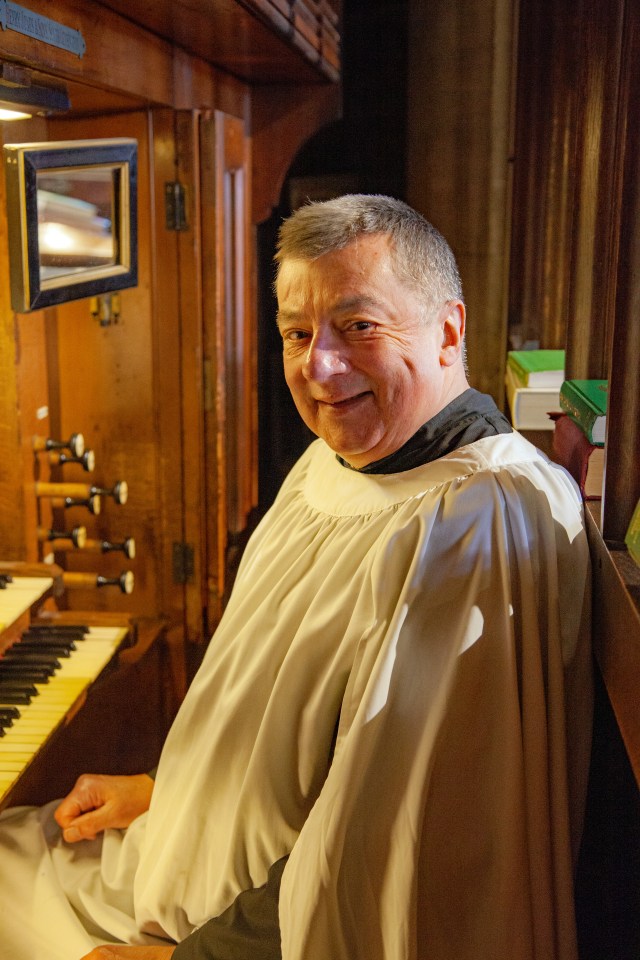
Born in Bristol, David studied Classics at Durham University. He quickly became involved in the music scene, singing in a number of choirs among which were the choirs of University and Hatfield Colleges, Durham Choral Society and Durham Chamber Choir. He also performed lead roles with Durham Light Opera Group.
In 1970 David was appointed Organist and Choirmaster of St Oswald’s Church, a position he held for four years. This was the church where John Bacchus Dykes, the composer of well-known hymn tunes, was vicar in the nineteenth century.
Following university David became a teacher at Rutlish School in Merton Park. Originally employed as a teacher of Latin, he taught a variety of subjects over his 25 years at the school, including Music, History, English, French and Geography!!
While at Rutlish he completed an MA in Medieval Studies and a Diploma in French.
After Rutlish, David taught Classics for 18 years at Channing School in Highgate. He was director of the Senior Choir and organist for the annual Carol Service.
When he first moved to London David was appointed organist at St Mark’s Wimbledon. He was a long-time member of Merton Opera (later Merton Abbey Opera) and was appointed conductor of Morden Park Choral Society. He also conducted Wimbledon United Choirs in their annual performances of sacred music for Good Friday.
David has been Organist and Choirmaster of All Saints for over forty years. Since retiring from teaching, he has enjoyed gardening and travelling. A particular joy has been to visit various cathedrals up and down the country and abroad.
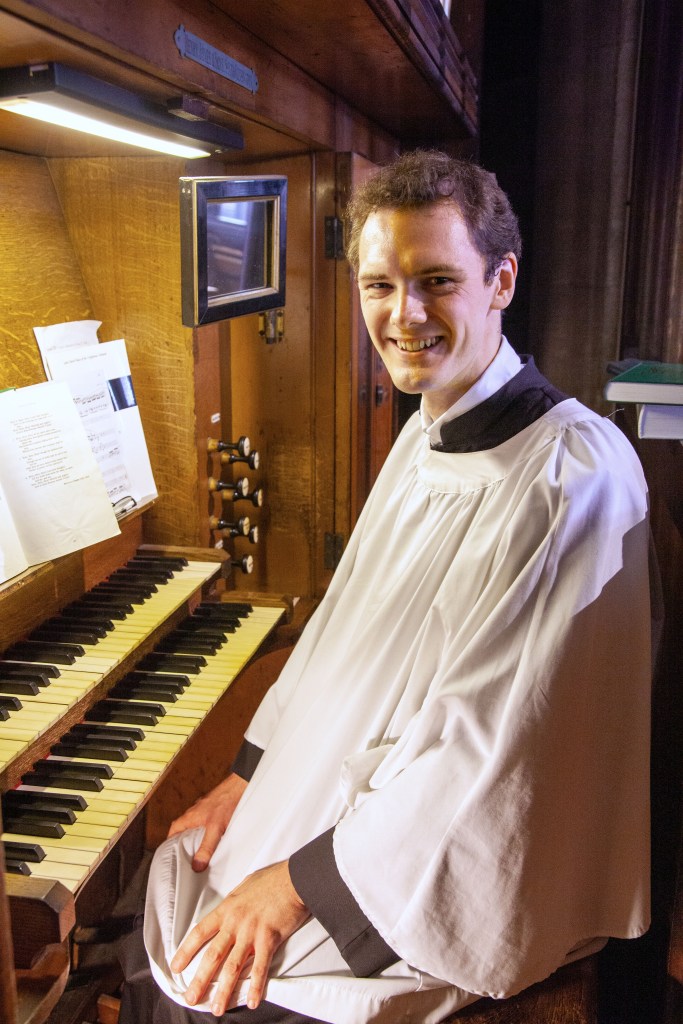
A proud Yorkshireman, Tom was born and raised in God’s Own Country before studying history and politics at the University of Edinburgh.
While a student, Tom was the Penny Turnbull Organ Scholar at St Peter’s Episcopal Church, Lutton Place.
After moving to St Albans, Hertfordshire to join a local government graduate programme, Tom was appointed Assistant Organist within the Parish of St Stephen with St Julian.
Now living in South Wimbledon and working for the City of London Corporation, he is delighted to be joining the music team and congregation at All Saints’. Tom was taught by Ian Little (Ampleforth), Sheila Chisholm (Edinburgh) and Tom Winpenny (St Albans).
Our Choir
The choir lend musical support to all the major services as well as holding dedicated concerts in the church from time to time. Although a small band, they perform a variety of choral works, often with choirs from other churches.
Choir practice is usually on a Friday evening from 7.30.p.m. – 8.30.p.m. If you are interested in joining our choir please get in touch.
John Bacchus Dykes – David Coram
Question: What do the following hymns have in common – ‘Holy, Holy, Holy’, ‘The Lord is my shepherd’ and ‘Eternal Father, strong to save’?
Answer: They all have tunes to them written by John Bacchus Dykes.
The Rev. Dr. John Bacchus Dykes (what a splendid middle name!) MA, MusDoc, 1823 – 1876, was the author of over 300 hymns, many of which are still sung today.
Born In Kingston upon Hull in Yorkshire, he showed musical talent from an early age. He played the piano and violin and was organist at his grandfather’s church. He studied at Cambridge and, while not reading music for his degree, was active musically, taking lessons from Thomas Atwood Walmisley.
In 1849 he was appointed to the curacy of Malton in North Yorkshire before becoming a minor canon, later precentor, of Durham Cathedral. In 1862 he was appointed vicar of St Oswald’s, an ancient parish church within sight of the cathedral, across the River Wear, where he ministered until his death in 1876. An evangelical by upbringing he became an Anglo-Catholic in his Cambridge years. This brought him into conflict with the Low Church bishop of Durham, Charles Baring and his archdeacon, Edward Prest. This must have put him under a considerable amount of stress. As a priest he was known as a friend to the miners and he was obviously a very good preacher since many Methodists (Methodism was very strong in Durham at that time) used to come and listen to his sermons. His portrait suggests to me that he was a sensitive and kindly man.
My interest in Dykes was kindled when I became organist of St Oswald’s in 1970, a post which I held for five years. The congregation knew what hymns they liked and woe betide any organist who played an alternative tune to a hymn when a Dykes tune was available!
To return to the three hymns I mentioned at the start. Organists have a remarkable knowledge of the names of hymn tunes. Yes, they can be very boring people!
The titles of the hymns cited are quite interesting however. The tune for Holy, Holy, Holy’, a hymn to the Trinity, is called Nicaea. The Council of Nicaea was a gathering of bishops summoned by the Emperor Constantine in 623 AD to discuss matters of doctrine, including the nature of the Trinity. It is from this council that we get what is known as the Nicene Creed. ‘The Lord is my shepherd’ has the tune Dominus regit me (The Lord rules/guides me) which are the opening words in Latin of Psalm 23(22) – The Lord is my Shepherd. Finally ‘Eternal Father, strong to save’ has the tune Melita. Melita (Malta) was the place where St Paul was shipwrecked in AD 60. All those on board swam to safety, hence it is a suitable hymn ‘for those in peril on the sea’.
A few words on why many of Dykes’ hymns have survived the test of time. They are all memorable and easy for a congregation to sing. Their harmonies are interesting without being sentimental, although some would disagree (Vaughan Williams, an editor of The English Hymnal, only included six of his tunes, with some that were popular being assigned to an appendix). Also they often have musical features reflecting the words. For instance ‘Holy, Holy, Holy’ has three strong chords to the first three words, repeated to the same words in the last line, making a powerful statement of faith. Also in Eternal Father, strong to save’ the rising chromatic music to the petition ‘O hear us when we cry to thee’ perfectly encapsulates the impassioned prayer for deliverance in time of danger. Finally a hymn I have yet to mention – ‘Praise to the Holiest in the height’. This is hymn sung by a ‘choir of angelicals’ from the great poem ‘The Dream of Gerontius’ by John Henry Newman. This tells of the journey of the soul of a pious old man from his deathbed to judgment and then into purgatory. At All Saints I tend to play the aptly named tune Chorus Angelorum (Choir of Angels) by Arthur Somervell. This is a splendid tune, but there is also a tune by Dykes – Gerontius – which is frequently sung. With its simple word painting, ascending to a high note for ‘in the height’ before going down an octave for ‘in the depths’, it is a worthy setting of the text. I promise to play this tune next time we have the hymn, safe in the knowledge that in the eyes of the congregation of St Oswald’s I am playing ‘the right tune’!
Our Serving Team
All Saints has a group of about eight regular servers. There is usually a team of five servers for our Sunday Solemn Mass, comprising two acoltyes, a crucifer, thurifer and M.C. There is a single server at each of our Weekday Masses.
Some of our servers are members of the Guild of Servants of the Sanctuary and belong to the Chapter of the Incarnate Word – the Chaplain of which is Fr. Christopher. Members of the Chapter join All Saints’ for services on a regular basis throughout the year.

The team is led by our Sacristan, Patrick Wood.
 All Saints' Church, South Wimbledon